Video: Design Buckling Restrained Braced Frames in RISA-3D
The ability to design buckling restrained braced frames has been added to RISA-3D when you integrate your model from RISAFloor. In collaboration...

Try the Complete RISA Suite for
10 Days FREE

RISA Education

Video Library

Online Help

Get Support

About Us

The ability to design buckling restrained braced frames has been added to RISA-3D when you integrate your model from RISAFloor. In collaboration with CoreBrace, this new feature came as part of the release of RISA-3D v19.0.0 and RISAFloor v15.0.0.
The purpose of buckling restrained braced frames is such that the brace is used as a fuse to dissipate energy during a seismic event. The buckling restrained brace is composed of a steel core and a concrete case. These members are advantageous because the concrete case increases the buckling capacity of the steel core. This enables a more efficient and economical design. The integration of RISAFloor and RISA-3D fits well with the split gravity and lateral design requirements for the BRBF system. The framing members such as columns and beams can be designed in RISAFloor under gravity loads to meet the requirements of them resisting gravity loads without BRB braces. After the model is directed to RISA-3D, users can add BRB braces to perform the lateral load design for the whole system.
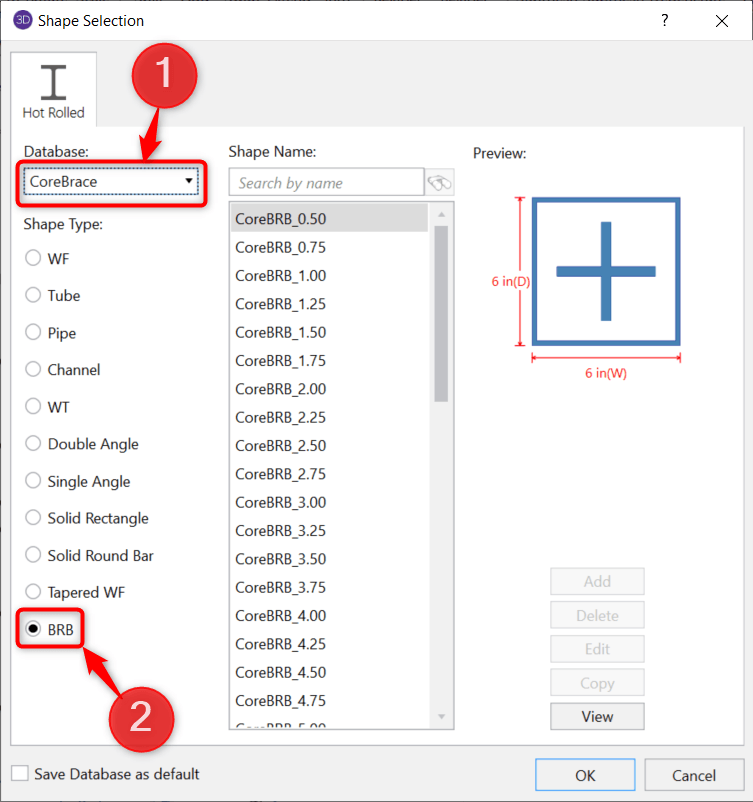
The buckling restrained braces can be accessed and assigned through the Hot Rolled Steel shape database by selecting the CoreBrace from the Database dropdown menu and selecting BRB as the Shape Type.
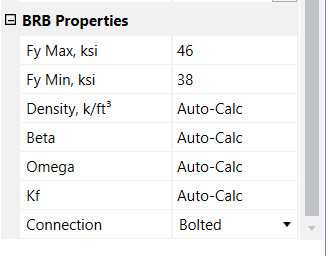
When a buckling restrained brace is chosen, additional properties become available in the Properties Panel including the upper and lower bounds of the yield strength, the density, the compression strength adjustment factor, the strain hardening adjustment factor, the stiffness modification factor and the connection type. If “Auto-Calc” is used for any input, the program will calculate the associated BRB properties based on brace geometry and connection types using empirical equations provided by CoreBrace. After the preliminary design, users can update these properties with explicit values provided by the brace manufacturer (e.g. CoreBrace) for each batch of brace products.
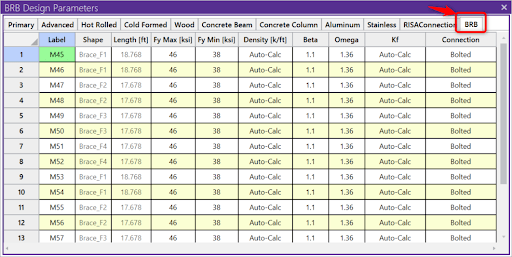
These properties may also be modified on the BRB tab within the Members spreadsheet.
Per requirements of AISC 341, gravity loads will be ignored in brace design. The program only considers loads under lateral load categories (e.g. EL, WL, NL, RSA loads) in brace design.
The BRBF seismic design rule shall be applied to all members within the frame. The Frame Type designation (BRBF) will ensure the program uses the appropriate code requirements for seismic detailing checks. The inclusion of capacity-limited load combinations will optimize the column and beam design in the buckling restrained braced frames per braces’ capacity-limited forces per AISC 341.
For more information on the implementation of capacity-limited design in RISA-3D, please refer to the following article:


The ability to design buckling restrained braced frames has been added to RISA-3D when you integrate your model from RISAFloor. In collaboration...
RISA-3D includes the ability to design steel structures for seismic provisions found in AISC 341 and AISC 358 including moment frames and braced...

With the release of RISA-3D v19.0.2, you can now design special concentrically braced frames (SCBF) as well as buckling restrained braced frames...