 By: Admin

Adding Roof Parapets in RISAFloor
RISAFloor v11 now includes the option to add parapets and parapet loading to a building.

Try the Complete RISA Suite for
10 Days FREE

RISA Education

Video Library

Online Help

Get Support

About Us
One of the most overlooked design criteria for commercial buildings is the tendency of the floor system to bounce or vibrate due to human footfalls. Excessive vibration of the floor system is a serviceability issue, and can lead to annoyance or concern from the building’s occupants.
Fortunately, RISAFloor has the ability to check the floor system’s performance in this regard, based on the criteria defined in AISC Design Guide #11.
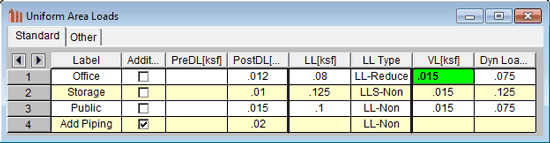
When you define area loads in RISAFloor, one of the definitions is for Vibration Load (VL). This represents the actual live load anticipated to be present on the floor. While typical design live loads can be upwards of 80 psf, the true live load (which will assist in dampening the floor vibration) in a commercial building is typically less than 20 psf.
During solution the program determines the natural frequency of the floor system, considering the self weight of the beams and deck, as well as the additional Vibration Load, and compares that against a dynamic excitation caused by a person walking. The result is an expected floor system acceleration (%g), which can be compared against allowable accelerations for different building types.
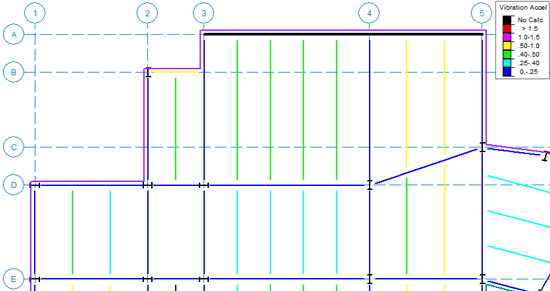
You can review the vibration results either through the vibration spreadsheet, or graphically through Plot Options:
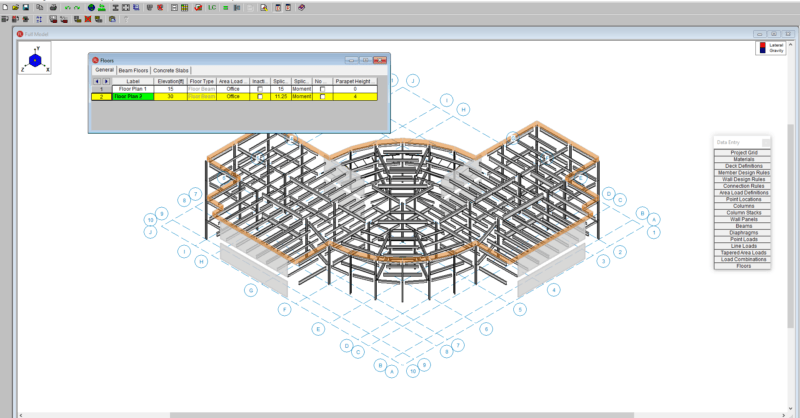
RISAFloor v11 now includes the option to add parapets and parapet loading to a building.

RISAFloor does not record the applied area loads in a spreadsheet. To simplify modeling, it instead assumes a default area load over the entire...

RISAFloor uses the Area Load Definitions spreadsheet to define area loads available for use on a floor.