 By: Admin
Making a Time History Animation Video
Time history analysis solves for normal analysis results (joint displacements, member forces, code checks, etc.) based on loading that varies with...

Try the Complete RISA Suite for
10 Days FREE

RISA Education

Video Library

Online Help

Get Support

About Us
The Pacific Earthquake Engineering Research center (PEER) has a large library of measured earthquake records. Below is an example of how to quickly convert one of these records into a format that can be imported into RISA.
The main header indicates the information is for the Northridge earthquake measured in a particular direction at a particular station. This is then followed by information that gives the total number of records (5200) and the time step (0.01 sec) between each record. The units are of g which is what RISA expects so it’s not necessary to specify a multiplier. However, for clarity the RISA input file specifies a multiplier of 1.0 for clarity.
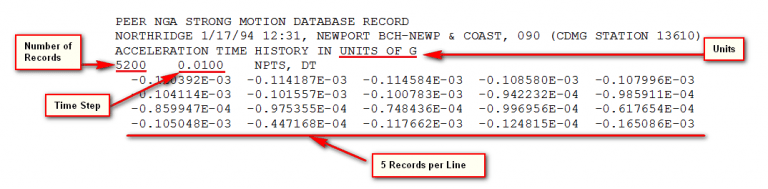
In the PEER txt file, the header name is very long so we’ll use an abbreviated name in the RISA file: “NORTHRIDGE 090”. The time step of 0.01 seconds and number of records per line (5) needs to be specifically entered as shown below.
One important difference is that the original PEER file lists the total number of data points whereas the RISA import lists the number of lines of data, not the total number of records. Because we have five records per line, this becomes 1040 rather than the 5200 shown in the original PEER file.
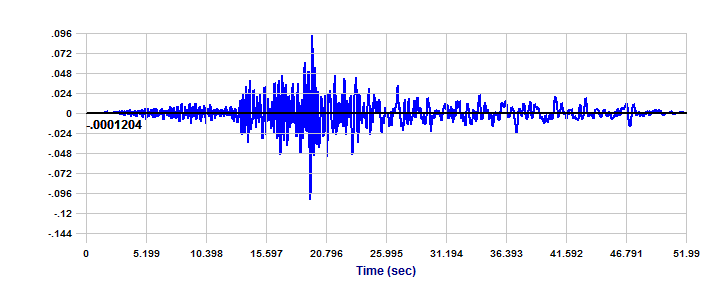
Below is an image of what this record looks like when imported into RISA-3D.
Time history analysis solves for normal analysis results (joint displacements, member forces, code checks, etc.) based on loading that varies with...

New in RISA-3D v14 is the introduction of a Time History analysis feature. Time history functions may be generated directly in the program based...
In structural engineering, a modal analysis uses the overall mass and stiffness of a structure to find the various periods at which the structure...