What is a Rigid Link in RISA-3D?
A rigid link is a member element in RISA-3D that can be used for many advanced modeling procedures. It is so useful that it is included as one of...

Try the Complete RISA Suite for
10 Days FREE

RISA Education

Video Library

Online Help

Get Support

About Us
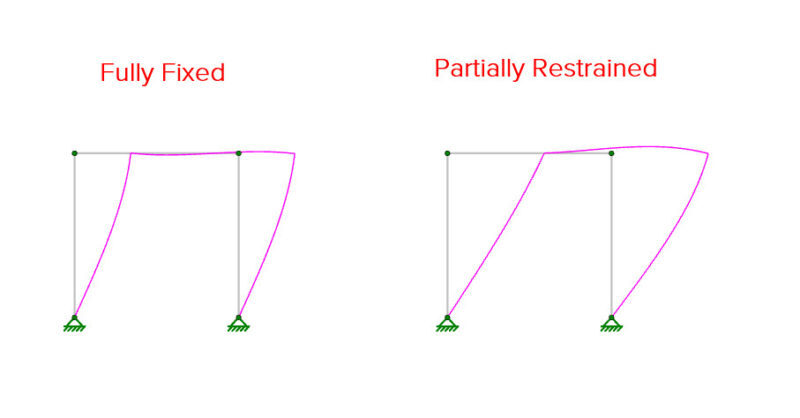
RISA-3D v17.0 now has the ability to model partial fixity member end releases. Partial fixity end releases can be utilized in RISA to model the behavior of a partially restrained or semi-rigid connection that cannot be idealized as fully fixed or pinned. Partially restrained connections are common in seismic moment frame systems and their semi-rigid rotational behavior can now be modeled in RISA-3D.
A partial fixity end release reduces the rotational stiffness at the member end joint by applying a rotational spring constant value entered by the user. RISA-3D uses the Euler-Bernoulli beam formulation to introduce this spring constant in the stiffness matrix. Partial fixity end releases can be applied in the Properties Panel by clicking on the ellipses the I or J end release cell:
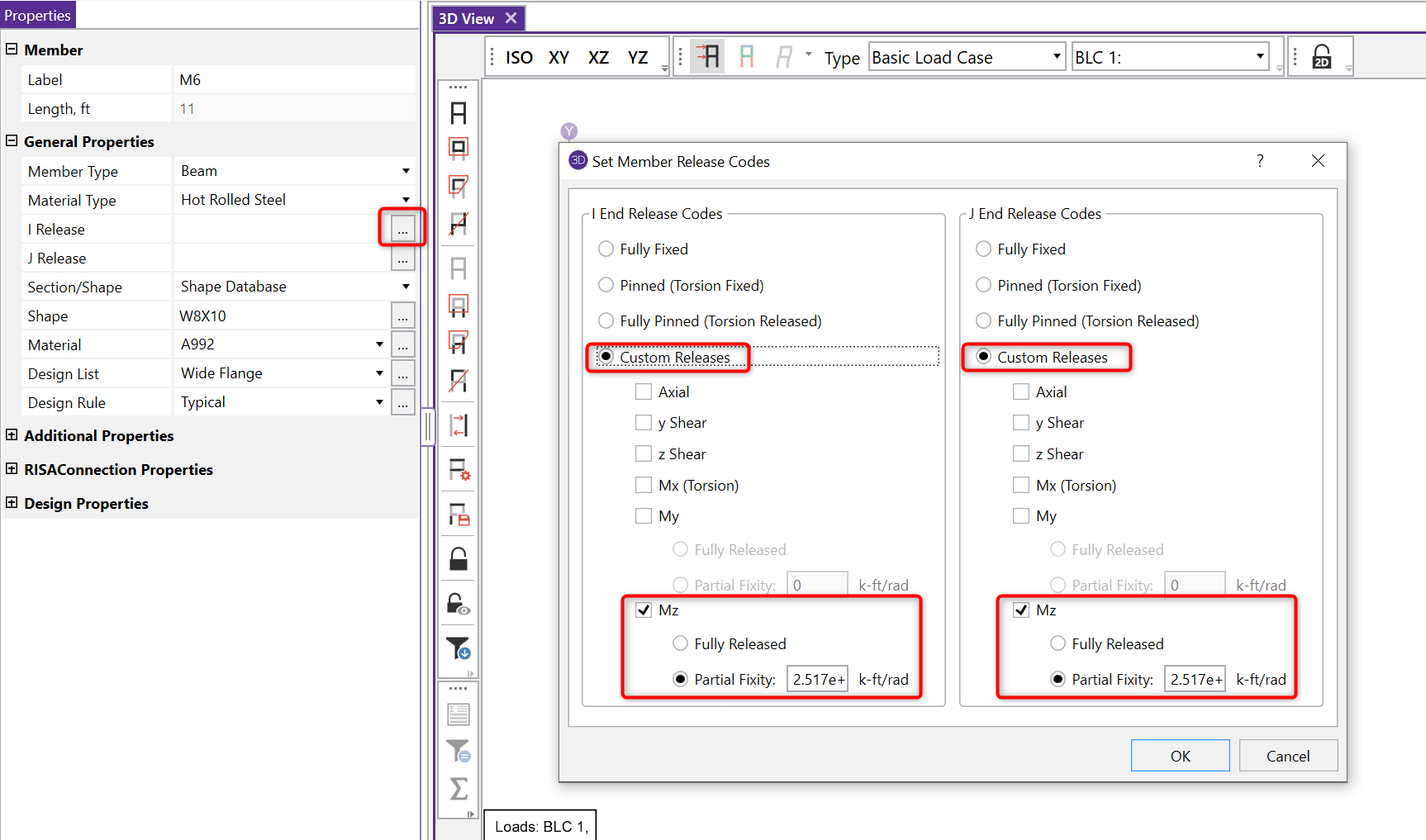
Once a rotational stiffness is applied, the connection at that member’s joint will become more flexible as they are partially restrained. Graphically, the end release will show a symbol to designate that a partial fixity end release has been assigned.
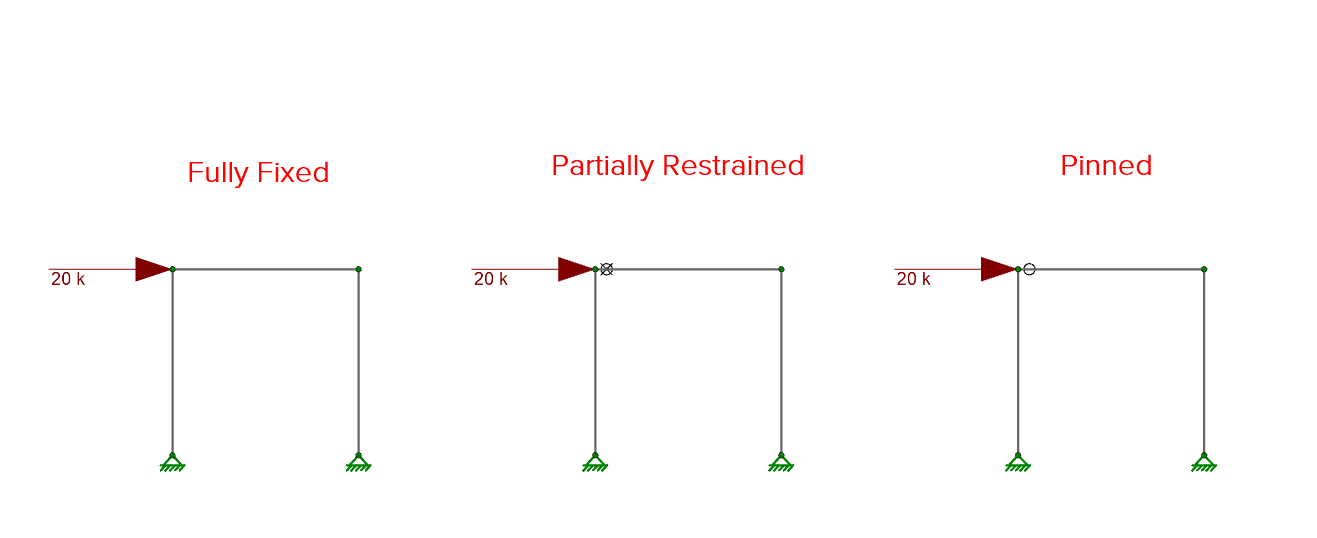
In the three examples above, the various frames have a beam to column connection that is either fixed, partially restrained, or pinned. The second frame beam has a rotational partial fixity member end release a stiffness of 1.0e+5 kip-in/rad in the Mz direction. There is a lateral earthquake load applied to the frame which we will compare the results for each case.
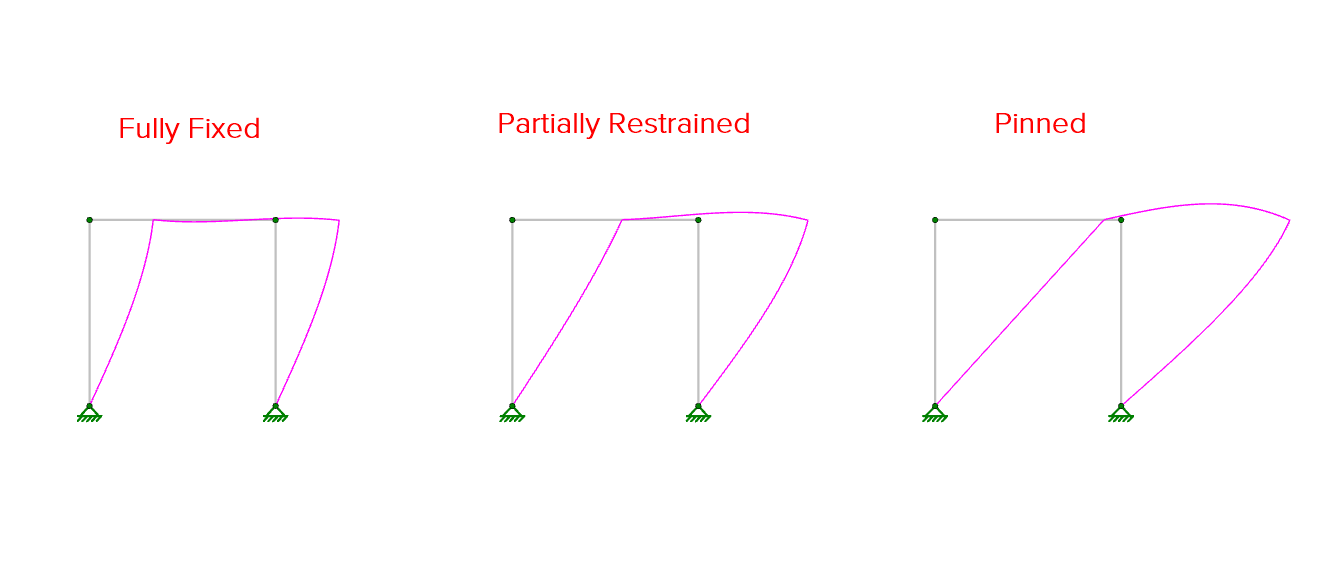
After running the analysis and reviewing the deflected shape, the deflection results are as we expect. The deflected shape shows the fixed connection deflects the least while the pinned connection deflects the most. The partially restrained connection deflects somewhere in the middle to represent the semi-rigid connection using an intermediate stiffness of the partial fixity member end release.
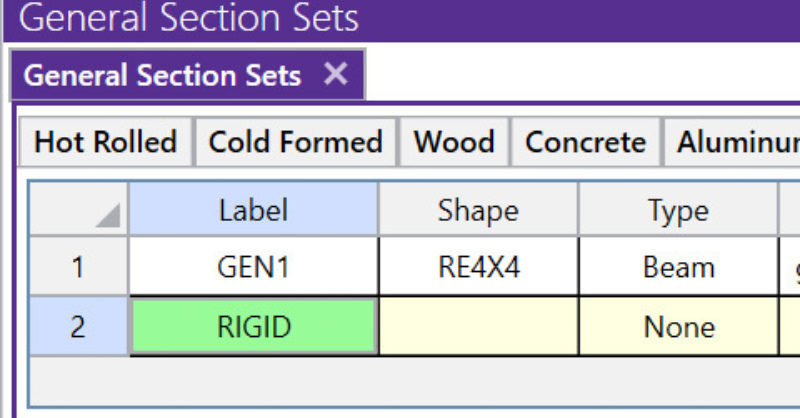
A rigid link is a member element in RISA-3D that can be used for many advanced modeling procedures. It is so useful that it is included as one of...
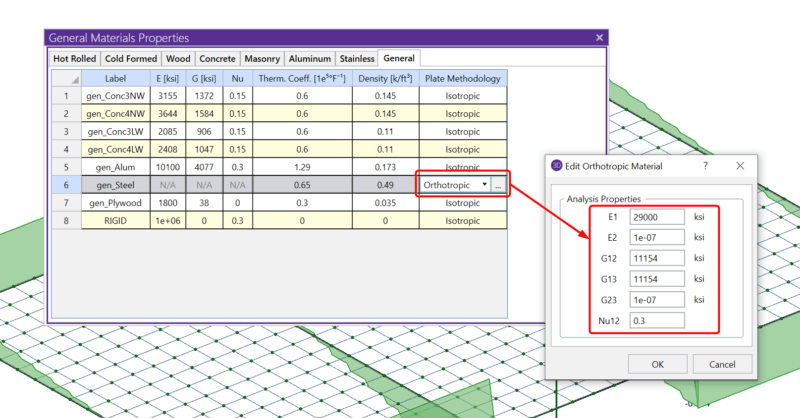
RISA-3D includes the ability to define the plate methodology of a material as orthotropic. In structural analysis and design, it may be useful to...
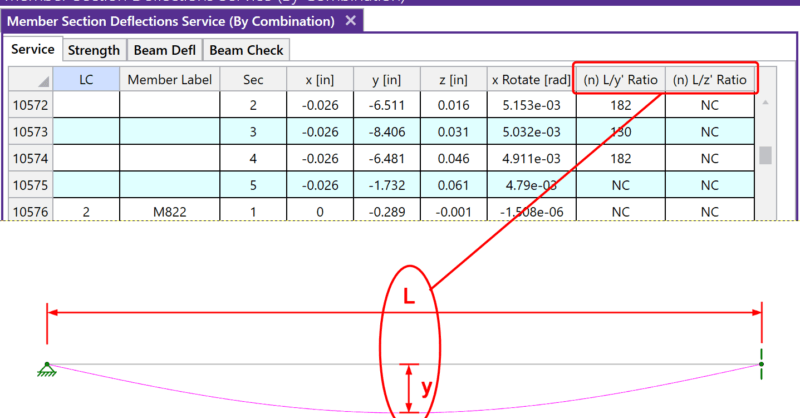
After solving a model, you will see in the Member Deflections spreadsheet the following deflection ratios: