New Updates to Steel Joists in RISAFloor
As a floor-by-floor design software, RISAFloor includes robust features for the design of steel joists, including standard joists, long-span...

Try the Complete RISA Suite for
10 Days FREE

RISA Education

Video Library

Online Help

Get Support

About Us
The Steel Joist Institute (SJI) has developed a Virtual Joist Girder table which converts common joist sizes into equivalent wide flange beams for use in RISA-3D.
Link: SJI: Virtual Joist Girders Table
The engineer should use these Virtual Joist Girders in their analysis model whenever the girders are part of a lateral frame. This should result in analysis assumptions for the strength and stiffness of the member that are closer to what the joist provider can realistically provide. This will lead to better communication between the EOR and the joist manufacturer, resulting in a quicker, more efficient design process.
Virtual Joist Girders are included as of RISA-3D v11 released December 2012.
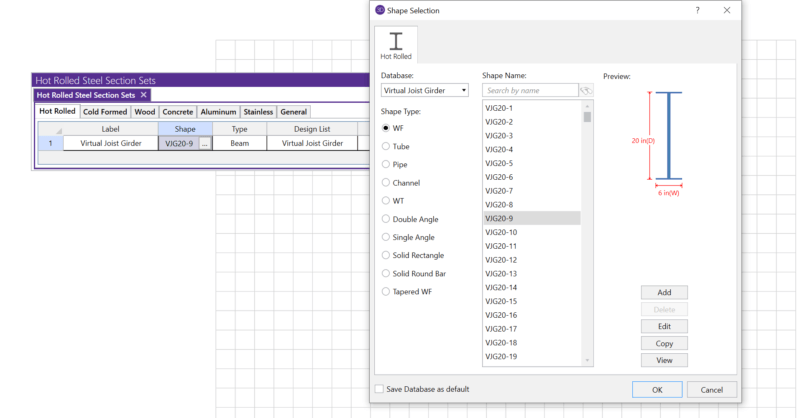
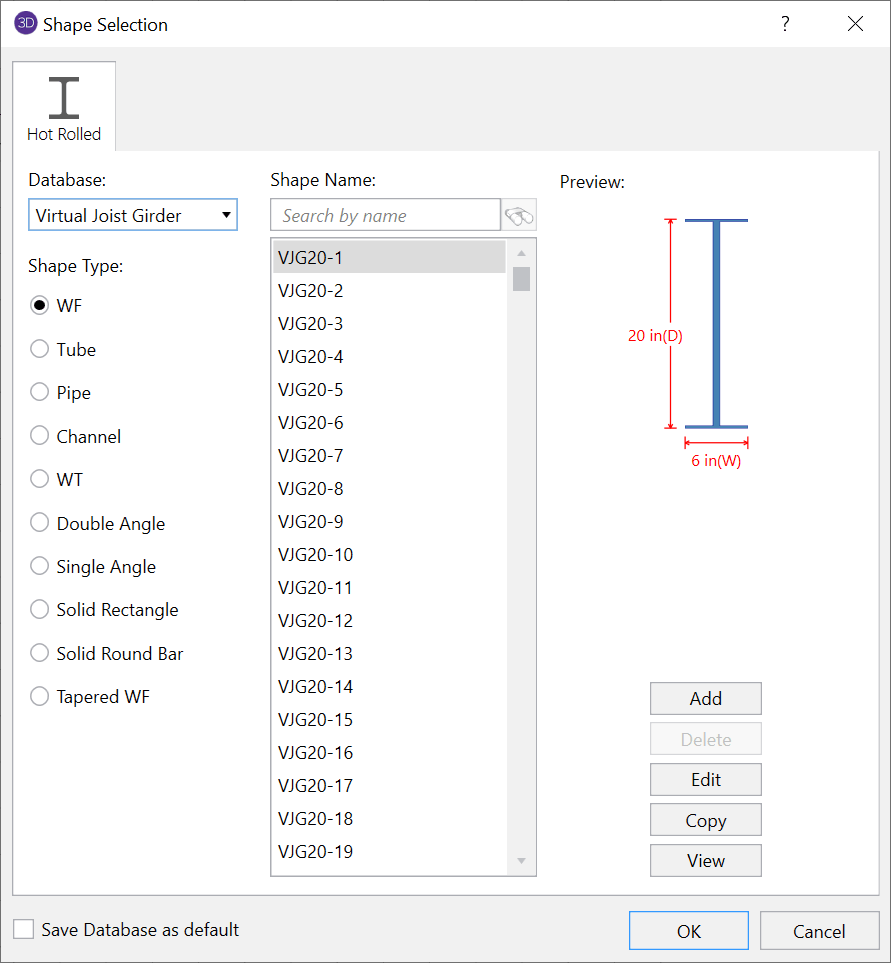
The Virtual Joist Girder database will be listed as one of the database options on the Hot Rolled tab of the Shape Selection dialog as shown to the left.
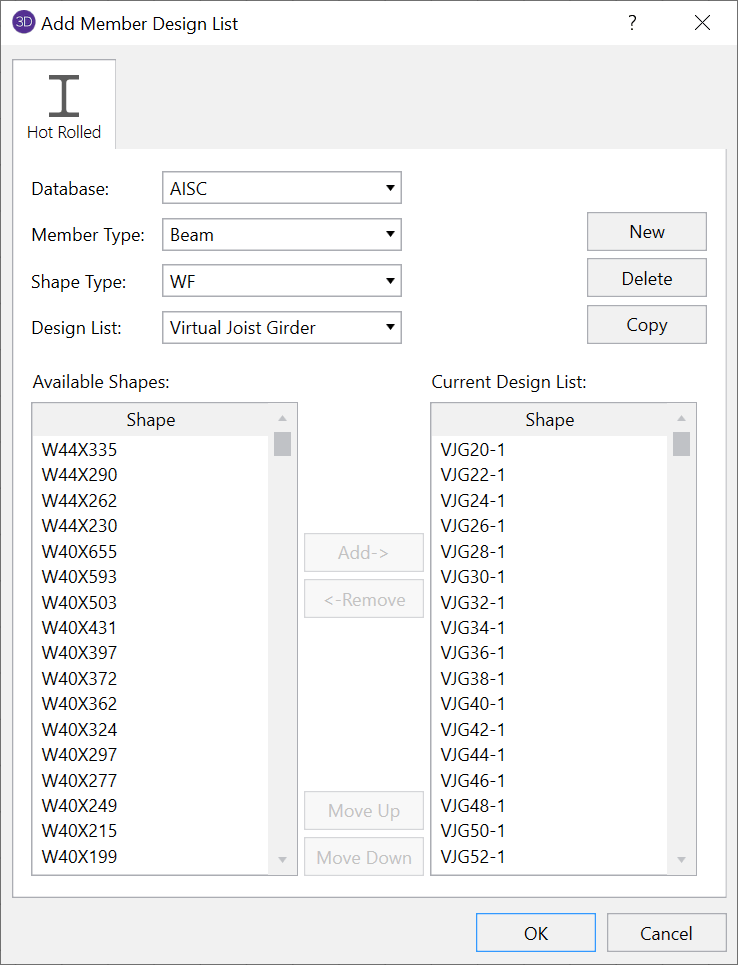
There is a new design list used referencing all the shapes in the SJI Virtual Joist Girder table. This design list is used as part of the RISA-3D optimization or redesign routines. A Virtual Joist Girder option will appear in the Design List as shown in the Draw Members dialog to the right.
Note: This only appears when the Material is set to Hot Rolled Steel and the Member Type is set to Beam.
The RISA optimization is done based on cross sectional area. So, if two shapes both satisfy stress or capacity checks , the program will choose whichever shape weighs less as the one which is considered to be more efficient. That shape will then be listed as the suggested shape as part of the redesign or optimization done by RISA-3D.

The only problem is that Virtual Joist Girders base their cross sectional area solely on the chord area. Therefore, a VJG20-1 is assumed to weigh exactly the same as a VJG40-1. That cannot be the case, but that is currently how the virtual joist girder tables work. As such, the optimization routines in RISA may pick deeper shapes than would truly be most efficient. For that reason, it is suggested that the engineer specify reasonable depth restrictions when using the RISA optimization routines for virtual joist girders.
Unbraced Length: Currently, SJI is suggesting using an unbraced length equal to zero for the top flange of VJG members. However, this may not be appropriate for the bottom flange of the beam for VJG members that are part of moment frames.

As a floor-by-floor design software, RISAFloor includes robust features for the design of steel joists, including standard joists, long-span...

RISAFloor has the capability to design wood I-Joists based on tables provided by the manufacturer, or provided by you. When modeling beams in...
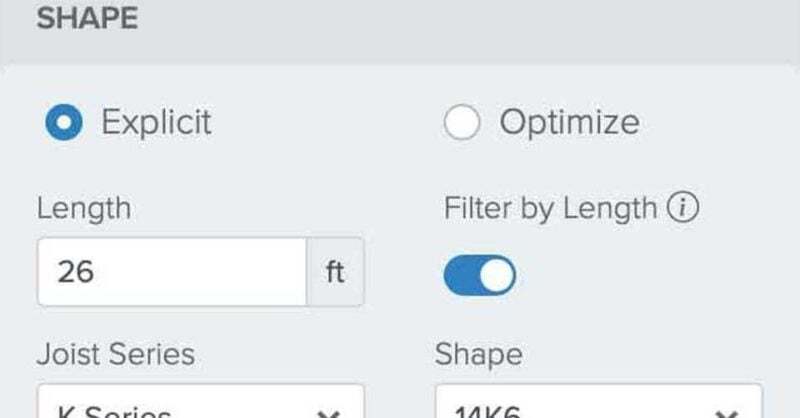
Open web steel joist design is now available in RISACalc per the SJI 43rd/44th and 42nd Editions! The available joist series include K-Series,...