
Tips & Tricks

December 29, 2025

What’s New for IBC 2024 in RISA: A Closer Look

With RISA’s latest release of RISA-3D v23.0.1, we’re continuing to expand support for IBC 2024, helping engineers stay aligned with the latest building code requirements as adoption accelerates across the U.S.—including federally funded projects. This release builds on v23.0.0 ASCE 7-22 enhancements and adds key material design updates that move RISA further into full IBC 2024 compliance. New Material Design Updates Supporting IBC 2024 The upcoming release introduces several important design code updates referenced by IBC 2024, including: Steel Seismic design per AISC 341-22 Prequalified connections per AISC 358-22 Continued support for AISC 360-22 (16th Edition) steel design Ongoing updates to the hot-rolled shape database, including compatibility with both 15th and 16th Edition steel manuals These updates support modern seismic detailing requirements and ensure consistency with current steel industry standards. Masonry Masonry design per TMS 402-22, aligning with the latest strength and serviceability provisions adopted by IBC 2024. Key updates include: Revisions to shear design equations, including clarified definitions of shear area as outlined in Table 4.4.5, improving consistency and transparency in shear capacity calculations. Updated strength reduction factors for flexure and combined flexure + axial. Unlike previous editions that used a fixed ϕ-factor of 0.9, TMS 402-22 introduces tension-controlled,…

Read More

Determining Masonry Wall Compression Block Depth Value
August 18, 2020

Determining Masonry Wall Compression Block Depth Value "a"

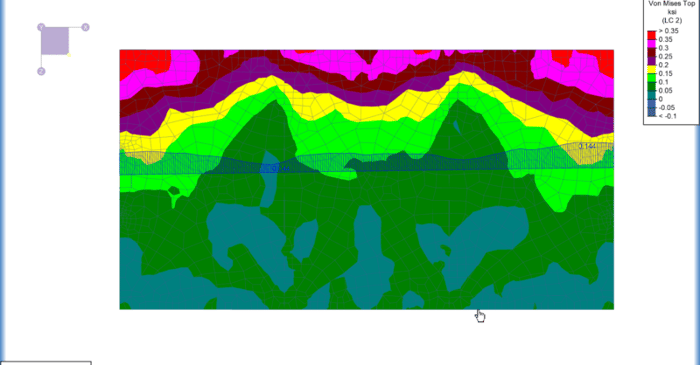
When determining the Depth of Compression Block value of ‘a’ in a Masonry Wall design based on the equation a = (As * fy)/(0.8 * fm * b) in a RISA-3D model, it is possible to see a small variance in the program results versus a traditional hand calculation using this typical equation. The reason...

Read More
Improving Mass Participation in RISA-3D
July 21, 2020

Improving Mass Participation in RISA-3D

In structural engineering, a modal analysis uses the overall mass and stiffness of a structure to find the various periods at which the structure will naturally resonate, along with the frequencies of vibration of the structure. In RISA-3D, the modal analysis is a prerequisite to the response...

Read More
Expanded Results for Contour Plots
July 7, 2020

Expanded Results for Contour Plots

Color contours and gradients can be very helpful to visualize the forces/stresses of plates and wall panels. But did you know there are other design tools that can be helpful in analyzing and understanding these contours? The family of Internal Force Summation Tools (IFST, IFST Wall and IFST Slab)...

Read More
Why is my force demand higher than what is reported in my force…
May 19, 2020

Why is my force demand higher than what is reported in my force…

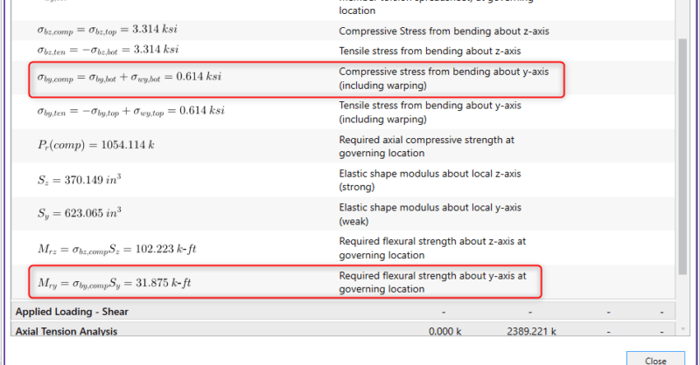
A question that we are asked from time to time in technical support is “why is my required force higher than what is reported in my force diagrams”. For instance, in the detail report below we can see that the maximum moment about the member’s weak axis is 28.9 k-ft. However, the required weak axis...

Read More
RISA-Tekla Link v10 Released
May 7, 2020

RISA-Tekla Link v10 Released

The release of the RISA-Tekla Link v10 introduces compatibility with Tekla Structures V2020. This update of the link includes the following features as well as other enhancements:

Read More
How Do Flexible Diaphragms Work on Sloped Roofs?
April 23, 2020

How Do Flexible Diaphragms Work on Sloped Roofs?

RISAFloor supports the use of flexible diaphragms on both flat and sloped roofs. Before reviewing the workflow for utilizing a flexible diaphragm on a sloped roof, it makes sense to review and understand the basic behavior of flexible diaphragms within RISAFloor. To do this, please first review the...

Read More
RISA-3D v18.0.4 Released
April 15, 2020

RISA-3D v18.0.4 Released

Over the last few weeks, we have been working hard to add the features and functionality that our customers have requested as well fix some of the issues that have been reported. With that in mind, we have prepared a new update of RISA-3D (v18.0.4) that includes the following features as well as...

Read More
Understanding Out-of-Plane Shear Capacity of Concrete Wall Panels
April 7, 2020

Understanding Out-of-Plane Shear Capacity of Concrete Wall Panels

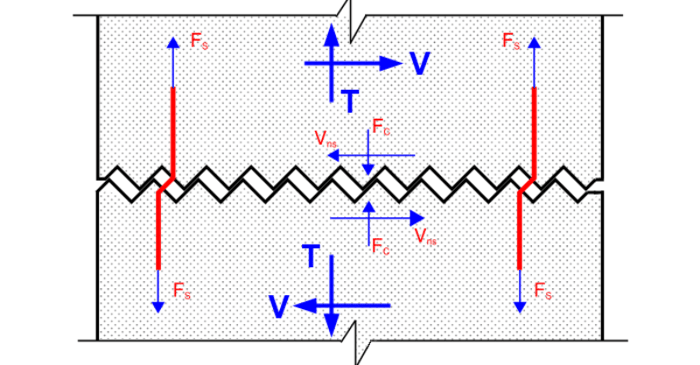
When designing concrete shear walls for lateral loading, RISA-3D includes design checks for both in-plane and out-of-plane shear. In the condition where a concrete wall is under both axial tension and out-of-plane shear, the out-of-plane shear limit state for a specific region within the concrete...

Read More